
FOMC Decision Day: This Pullback Is Pricing Rate Cuts, Not Rate Hikes
Falling equities are not discounting rate hikes. They are discounting rate cuts, and in a fiscal dominance regime that is the warning. Plus defined risk put spreads on Meta and Microsoft into tonight

The market walks into today’s FOMC decision, roughly one hour from print, with two conversations running in parallel: the tape’s, and the one on social feeds. The tape is showing a classic defensive rotation. Apple has retaken the top slot in the MEGA9 and posted a clean +0.94% session, Berkshire Hathaway printed +3.06%, and roughly 300 of the S&P 500’s constituents closed positive on the day. That is a breadth reading that quietly contradicts the notion of a broad equity unwind. The Nasdaq 100 sat out the move (net change 268.00 handles lower, YTD +7.84%), which is exactly what rotation from expensive concentration into cheaper cyclicals and cash-flow compounders looks like.
The social conversation, by contrast, has landed on a familiar story: this pullback and the Korean exchange sell-off are pricing rate hikes because inflation is sticky. That framing has the causality inverted.
Our read is the opposite. Falling equity prices are not discounting tighter policy ahead. They are discounting easier policy ahead, and easier policy in the current fiscal regime is what participants should be worried about.
Here is why the sign flips. At $39 trillion of federal debt and roughly $1.56 trillion of annual interest expense, the risk-free interest payout has become a structural transfer of capital from the government to private and institutional balance sheets. The law of large numbers has taken over: each incremental basis point on the debt stock produces a meaningful, guaranteed cash flow into portfolios that then re-risks that flow into equities, credit, and treasury coupons. In a fiscal-dominance regime, higher rates therefore contribute to equity valuations rather than compressing them, because the interest income channel dwarfs the discount-rate channel once the debt stock is large enough. That is what the last several years of nominal equity performance in the face of rising real yields has been telling us. Something only Magnelibra seems to understand!
Reverse the polarity and the mechanism reverses with it. When equities start pricing lower, they are pricing three things at once: the risk-free pickup shrinking as the market anticipates cuts, global economies slowing into the reason those cuts become necessary, and margin credit access tightening as risk conditions deteriorate. A bull-steepening curve (2s10s widening +0.6 bp to 32.3 bp today, 2s30s +1.6 bp to 81.7 bp, all yields lower by 3.1 to 4.7 bp) is the front-end version of that same message. This is not a market discounting a tightening scare. It is a market discounting the beginning of an easing cycle, with all of the growth and credit warnings that typically come with one.
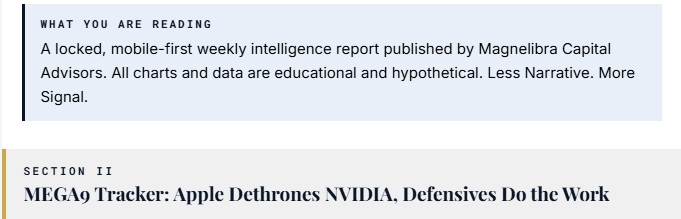
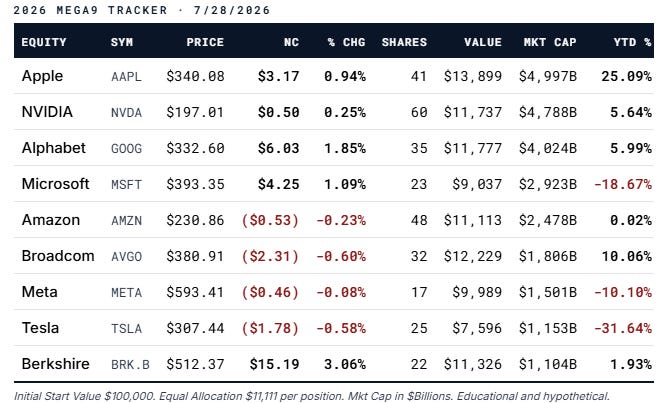
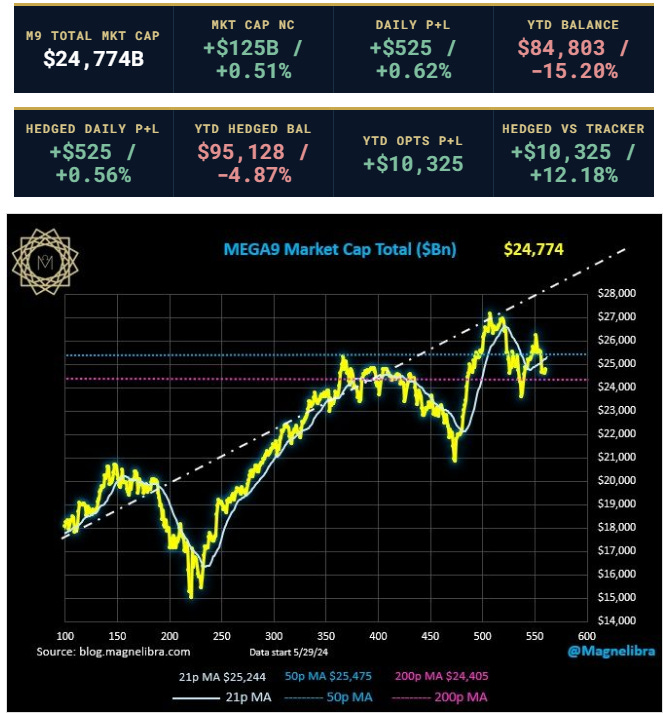
The MEGA9 equal-weight tracker closed the session +0.62% on daily P&L, with the underlying market-cap-weighted basket adding roughly $125 billion. Underneath that quiet headline, the composition matters more than the aggregate: Apple has reclaimed the number-one market cap slot at $4.997 trillion, Berkshire is the day's biggest percentage contributor at +3.06%, and Google, Microsoft, and Amazon carried the balance. The AI-adjacent names (NVIDIA, Broadcom, Meta, Tesla) either lagged or closed red. Read together, the top of the equity market is quietly rebalancing out of concentration risk and back into cash-flow durables and hedged financials, which is precisely the pattern the MEGA9 with a QQQ options overlay is designed to capture.
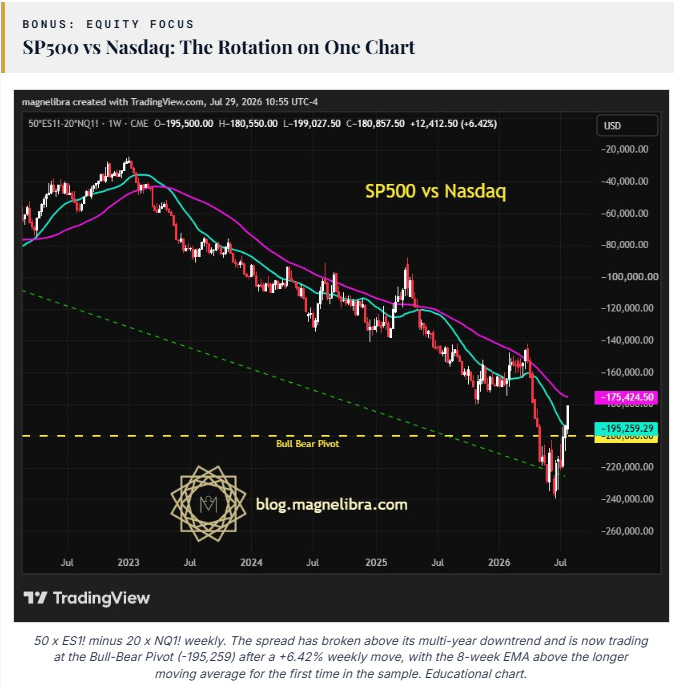
The SP500-versus-Nasdaq spread is the cleanest single picture of what is happening this week. The pair has spent most of 2023 through mid-2026 grinding lower in a persistent downtrend as the mega-cap tech complex outperformed the broader index. That downtrend has now been broken. The spread reclaimed the green trendline and is testing the Bull-Bear Pivot at roughly -195,000. Combined with the S&P 500 constituent breadth reading (roughly 300 of 500 names positive across recent sessions), this is a real rotation trade, not a one-day head fake.
That is worth pausing on. The story most participants are telling, that equities are down because rate hikes are coming, does not fit a rotation of this shape. When the market is genuinely repricing tighter policy, defensives, cyclicals, and growth all draw down together. What is happening instead is that capital is leaving one crowded corner (the Nasdaq mega-cap concentration) and re-entering another (broader S&P participation, financials, defensives). That is a positioning move, not a policy discount.
