

"Treasury doubled its long-end buyback capacity within hours of a 19-year high in the 30-year. Calling it 'QE Lite' misses what's actually coordinated."
“Treasury doubled its long-end buyback ceiling this morning, hours after the 30-year printed a 19-year high. The financial press is calling it QE Lite. The mechanism argues otherwise, and the coordination argument is the more interesting one. Full breakdown below."
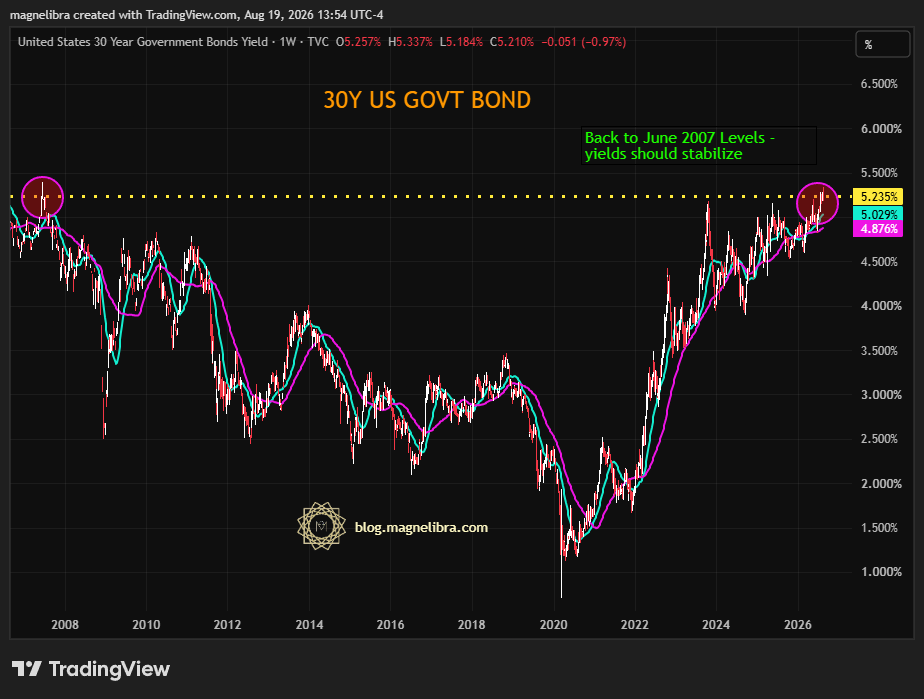
The US Treasury at 8:30am ET announced it will at least double the size of its liquidity support buyback operations in the 10 to 20-year and 20 to 30-year nominal coupon sectors, lifting the per-operation maximum from $2B to at least $4B, effective September 9 and running through the November 4 refunding. The 30-year US Treasury bond, which had printed a fresh 19-year high above 5.30% in Tuesday’s session, traded 9bps lower to 5.196% on the announcement; the 10-year note fell 6bps to 4.647%. The 2s30s curve flattened 7bp on the day, 10s30s 2bp. The dollar index slid 0.77% to 98.885, a 2.5-month low, while gold traded through $4,545, up 2.82% and a 2.5-month high.
We highlighted this 30 year yield area in a prior article so we aren’t surprised at the latest U.S. Treasury move to defend this level:
The tape read the move as liquidity support, and financial media moved quickly to a “QE Lite” framing. That label conflates two different balance sheets. Treasury’s buybacks are debt-management operations financed by issuing more bills to retire long bonds; the mechanism shortens the weighted-average maturity of debt outstanding without creating a single dollar of new reserves. Deutsche Bank’s desk note called it “effectively similar to the Fed’s Operation Twist,” and on the mechanics, that read holds up better than the QE framing does.
Standard access ($15/mo) unlocks the full Rates & Macro Snapshot, the fiscal-monetary coordination analysis, and the forward-looking watch list. Founders Circle ($500/yr) adds the daily FTS signal, the FMTP institutional book, and the Digital Currency Index. All designed as trade signals as a guidepost, as signal implementation or refinement to what you already trade with use.
Magnelibra Intelligence Reports publish ad hoc as conditions warrant, alongside the daily signals and weekly reports. Subscribe to receive the next one as it happens.
