Why We Think the Fed Ends Up Cutting, Not Hiking, Inside Six Months
Strategy Inc is running out of room to wait and see who is right.


The Fed's own dot plot just turned more hawkish. The bond market has spent the two weeks since telling it that it is wrong. We think the bond market wins this argument within six months, and Strategy Inc is running out of room to wait and see who is right.
The FOMC Got More Hawkish. The Bond Market Already Disagrees.
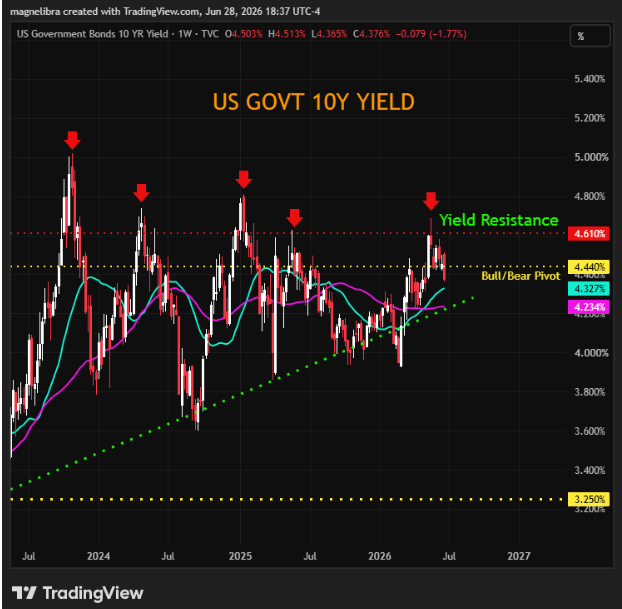
On June 17, the Fed held rates at 3.50 to 3.75 percent and released a dot plot that moved in the opposite direction of what most of the curve wanted: the median 2026 year end projection rose to 3.8 percent, up from 3.4 in March, with nine of nineteen officials now penciling in at least one hike. New Chair Kevin Warsh called the committee’s tone unambiguous. Bank of America responded by calling for three hikes. We laid out our objection to that premise two editions ago: hiking against 39 trillion in government debt transmits through the interest income channel before it transmits through demand destruction. The bond market has been casting its own vote since. The ten year has fallen from 4.509 to 4.372 in the two weeks since that meeting, breaking decisively through the 4.44 percent level that has acted as the pivot between the bull and bear case on yields for most of this year. The two year, five year, and thirty year have all moved the same direction. The Fed says hike. The curve says cut. One of them is going to be wrong, and it usually is not the bond market.
Equities Are Rolling Over
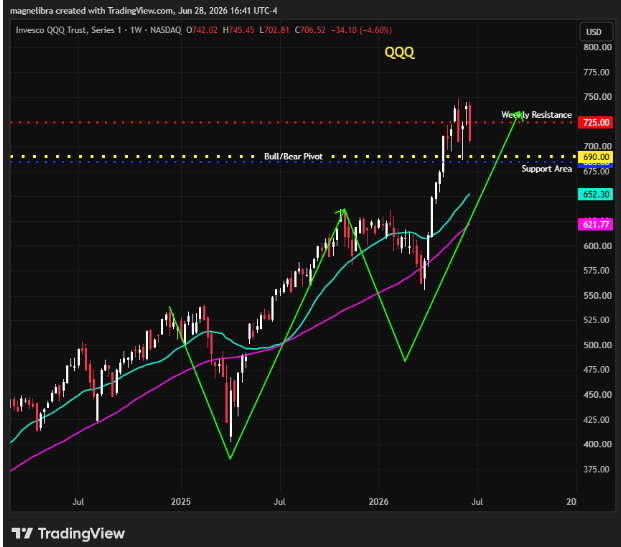
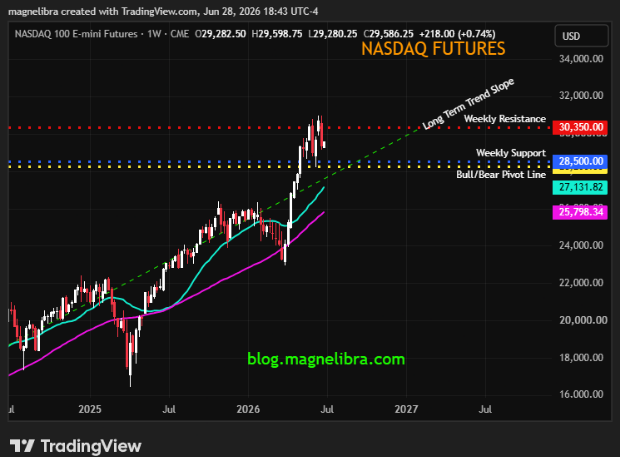
The technical picture across the major indexes is starting to match the yield curve’s message. QQQ closed the week at 706.52, down 4.60 percent, its sharpest weekly decline since the spring correction, slipping from a recent high near 745 and now testing the 690 bull/bear pivot from above for the first time since that level was reclaimed. The pattern across the last twelve months has been a series of sharp corrections followed by higher highs. What we are watching for now is the opposite: a series of lower highs, each rally weaker than the one before it, which is the technical signature of a market transitioning from trend to range, or range to decline. Nasdaq futures are down 4.86 percent year to date from their most recent peak. We are not calling a top. We are saying the structure of this rally is changing, and a market pricing three more hikes into that structure is pricing the wrong regime.
Why We Think the Fed Ends Up Cutting, Not Hiking, Inside Six Months
We have made this case before and we are making it again because the data keeps confirming it rather than refuting it. Real GDP growth is now projected at just 2.2 percent for 2026, the Fed’s own number, down from prior projections, even as the median dot moves toward another hike. Housing is the clearest transmission point: the average 30 year fixed mortgage has held in the high 6 percent range for months with no relief, existing home sales remain depressed, and home price growth is decelerating into outright softness in a growing number of metro markets. A Fed that hikes into decelerating growth and a softening housing market is not fighting inflation, it is manufacturing the conditions for the cut it will need to deliver six months from now. We think the committee ends 2026 closer to cutting than hiking, and that the next two payroll and housing prints matter more to that path than anything in this week’s dot plot.
The K-Shaped Economy Is Why the Aggregate Numbers Lie
Part of why this is so hard to see in the headline data is that the headline data increasingly describes two different economies. The top 10 percent of US earners now account for roughly half of all consumer spending, up from closer to 35 percent in the early 1990s, according to a recent Moody’s Analytics review of Federal Reserve data. Split by income quintile rather than decile, the story sharpens further: personal outlay growth for the top 20 percent has run at 8.3 percent since the pandemic against 4.5 percent for the bottom 80, with CPI inflation of 3.9 percent sitting almost exactly between the two. The top of the distribution has been spending through asset gains and is largely insulated from the financing cost of a 4 percent plus mortgage rate. The bottom 80 percent is not, and that segment is where a hiking cycle actually bites. An aggregate growth number built on top decile spending can look resilient long after the majority of households underneath it have already slowed down.
MSTR: mNAV Below 0.80x and Out of Good Options
Strategy Inc’s mNAV, the ratio of the company’s market value to the dollar value of its bitcoin holdings, closed the week at 0.79x. Below 1.0x, the mechanism that built this trade runs in reverse: issuing new shares no longer grows bitcoin per share, it dilutes it, because the company is selling equity for less than the bitcoin backing it is worth. MSTR is now down 45.8 percent year to date, materially worse than bitcoin’s own 31.6 percent decline, the leverage embedded in the structure cutting against holders on the way down the same way it flattered them on the way up. We have written about the STRC preferred stock’s negative convexity for months, and that mechanism is now compounding with this one: a market that will not fund new bitcoin purchases at an accretive price, and a preferred stock that gets more expensive to defend the lower everything else falls. Strategy’s own usual levers, common equity issuance and STRC issuance, are both constrained at the same time, by the same underlying cause. We do not see a clean way out of this that does not involve selling more equity at a discount, selling more bitcoin outright, or both.
I. Futures Market Trend Program
What You Are Reading
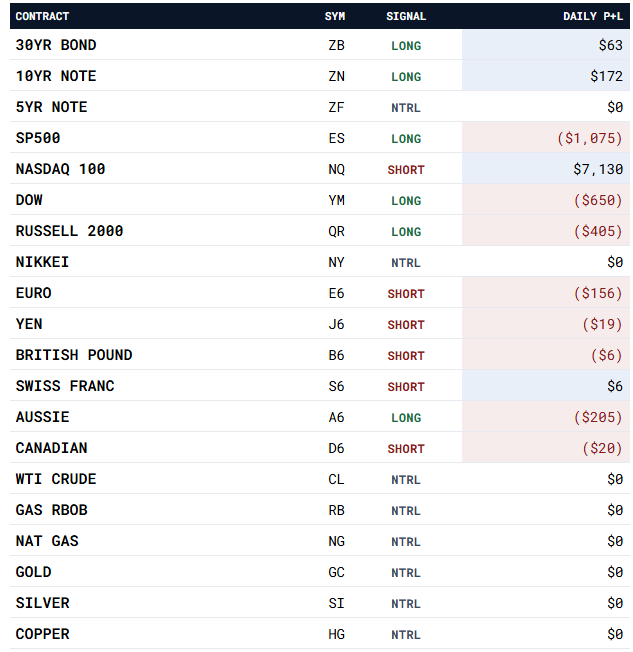
Systematic trend following across 20 financial and commodity futures markets. Each market carries an independent long, short, or neutral signal generated by the program’s trend model. Start value $250,000. This is not a live account and not investment advice.
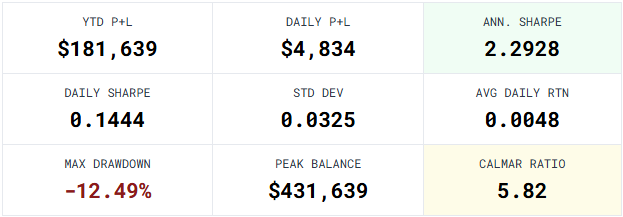
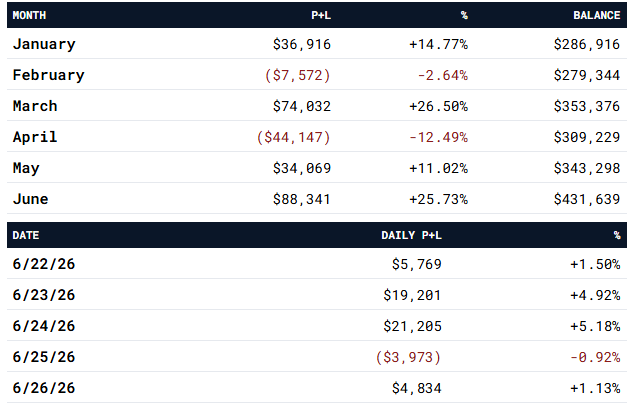
Max drawdown, peak balance, and the resulting Calmar ratio are derived from the monthly balance series (largest peak-to-trough decline still March’s $353,376 high to April’s $309,229 close; June’s $431,639 is the new high-water mark).
The short Nasdaq position is now the single best performer in the book by a wide margin, up $7,130 today and the clear beneficiary of the equity rollover we discussed earlier. The long bond sleeve, thirty year and ten year, finally turned modestly profitable as yields extended their decline. Gold remains neutral for a second straight week after flipping out of its short at support, and the rest of the commodity complex stays flat. June is now up 25.73 percent, the best month of the year, and the program sits at 72.66 percent year to date.
II. MEGA9 Tracker + Hedge
What You Are Reading
Hypothetical equal weight basket of the nine largest mega cap equities. Start value $100,000, $11,111 allocated equally to each of the nine names regardless of market cap, rebalanced by share count rather than by dollar weight day to day. The hedge overlay sells QQQ calls against the basket.
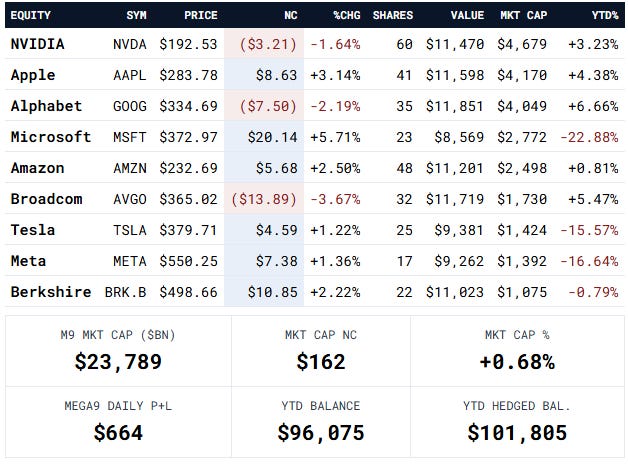
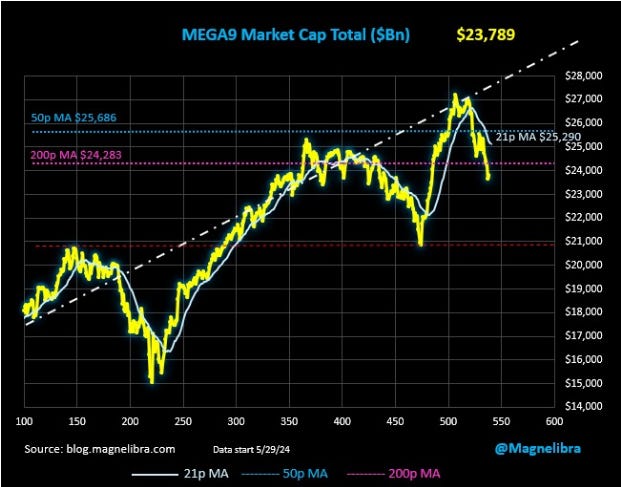
A bounce day for the basket, up $664, even as the broader Nasdaq fell hard, MSFT and AAPL leading with 5.71 and 3.14 percent gains. The basket's total market cap has fallen back to 23.789 trillion, now below all three moving averages (significant technically) on the chart, the 21 period at 25.290 trillion, the 50 period at 25.686 trillion, and the 200 period at 24.283 trillion. The hedge overlay's year to date edge over the unhedged tracker held at 5,730 dollars, 5.96 percentage points.
QQQ closed the week at 706.52, down 4.60 percent, breaking back below the 725 level that had acted as resistance and is now acting as a lid from above. The 690 bull/bear pivot is the level to watch from here. The 725 put we had been working to buy at 3.00 never filled: it traded as low as 5.23 during the cycle but never reached our level, so there was no hedge in place last week. This week we will look at putting on the QQQ 720 put for 3.00 or less for the July 2 expiry.
III. Interest Rate Futures
What You Are Reading
Interest rate futures track the price of the underlying note or bond contract, moving inversely to yield. A positive net change here means yields fell on the day.
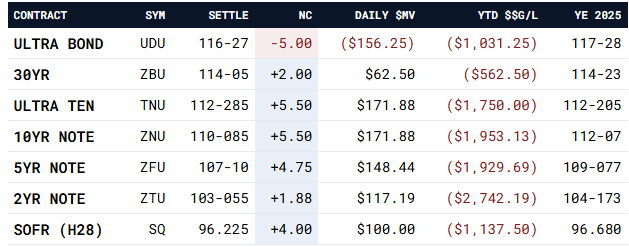
Every maturity gained again this week, extending the rally that began two editions ago. The Ultra Bond contract is the lone exception, down 5 ticks on the week as the very long end lags the broader rates rally, but it remains up $1,750 on the Ultra Ten contract and the belly of the curve continues to lead.
IV. US Treasuries & Yield Curve
What You Are Reading
Daily yield change reflects today’s settle against yesterday’s close. Total change is measured against the December 31, 2025 close. The 10 year’s break of the 4.44% level discussed in this edition’s lede is the headline move in this section.
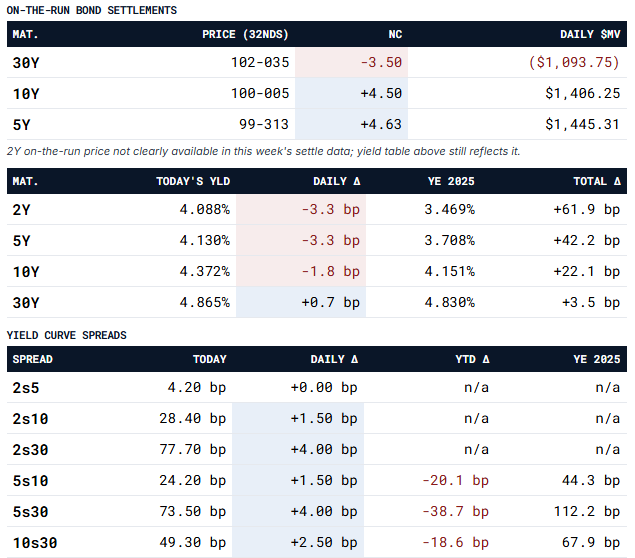
The ten year closed at 4.372 percent, through the 4.44 level that has marked the line between the bull and bear case on yields for most of this year. That is now 22.1 basis points above the December 31 close, the smallest gap of any maturity except the thirty year, which sits just 3.5 basis points above where it started the year. The curve is steepening from the front end, 2s10 up 1.50 basis points and 2s30 up 4.00, while the long end continues to richen versus the belly, the kind of move that typically accompanies a market pricing a slowing economy rather than a reacceleration.
The weekly chart makes the level explicit. The ten year closed Sunday at 4.376 percent, down 1.77 percent on the week, decisively through both the 4.440 bull/bear pivot and its own 21 and 50 week moving averages at 4.327 and 4.234. Every prior approach toward the 4.610 resistance line going back nearly two years has been rejected, the red arrows marking four separate failed attempts. We are now trading below the pivot for the first time since that pattern began, with the next structural support not until 3.250.
V. Equity Index Futures
What You Are Reading
Daily $ move and year to date $$ gain or loss are both computed per single futures contract at standard contract size, not on a notional index point basis.
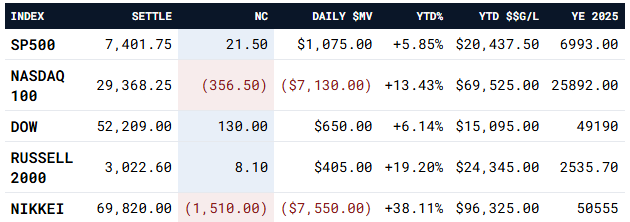
Nasdaq futures and Nikkei were the two clear losers on the week, down $7,130 and $7,550 per contract respectively, while SP500, Dow, and Russell all posted modest gains. That split, the largest and most richly valued growth index falling while the broader market holds up, is itself a rotation signal worth watching alongside the rollover discussed in this edition’s lede.
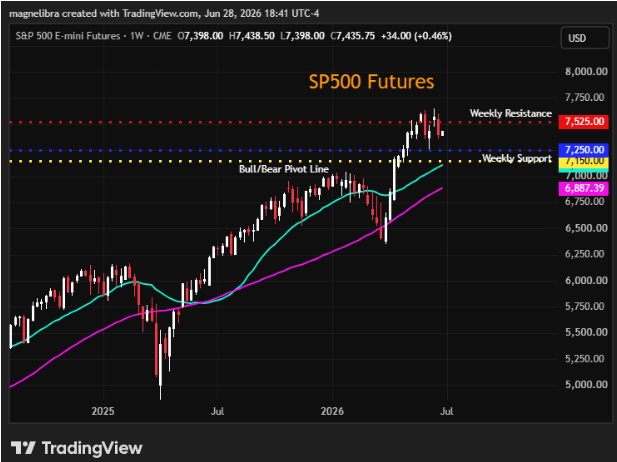
SP500 futures closed the week at 7,435.75, up a modest 0.46 percent, holding above the 7,250 weekly support and the bull/bear pivot line, with 7,525 the resistance level capping the most recent push higher. Unlike Nasdaq, the broader index has not yet broken its own structure, which is exactly why the divergence between the two matters: the rollover we are watching for is showing up first in the most crowded part of the market, not yet across the index as a whole.
Nasdaq futures tell the sharper version of the same story: a close at 29,586.25, up 0.74 percent on the day but still well off the 30,350 weekly resistance, after trading as low as 29,280.25 intraweek. The contract has broken below its own long term trend slope, the dashed green line on the chart, for the first time since the move began, and is now leaning on the 28,500 weekly support with the bull/bear pivot line sitting just beneath it. A failure to reclaim the trend slope from here would be the clearest confirmation yet of the lower highs pattern flagged in this edition's lead in.
VI. Currencies & Bitcoin
What You Are Reading
All currency pairs are quoted against the US dollar in futures terms. Bitcoin is shown spot.
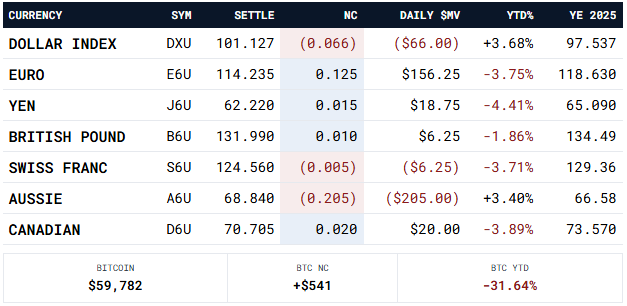
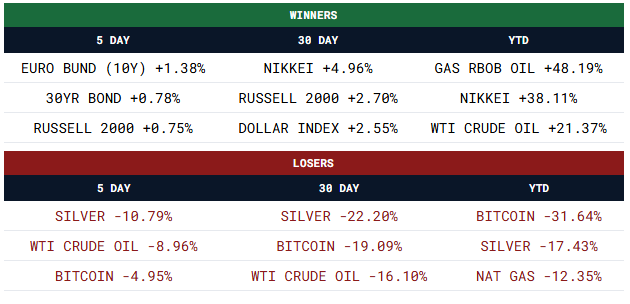
The dollar index slipped fractionally, down 0.066, but remains up 3.68 percent on the year, a dollar bid that has persisted through this entire disinflation repricing, consistent with the flight to quality framing from two editions ago rather than a rate differential trade. Bitcoin bounced modestly to 59,782, still down 31.64 percent year to date and the worst YTD performer of any market we track this edition.
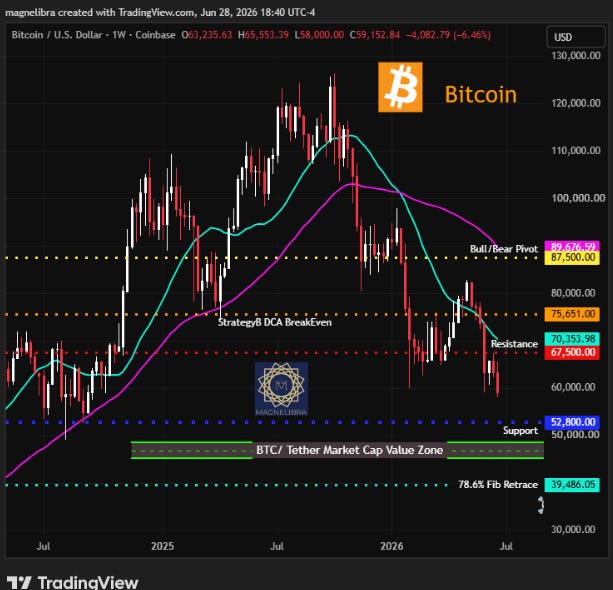
By Sunday evening the bounce had already given way: the weekly chart shows bitcoin back down to 59,152.84, off 6.46 percent on the week and printing a fresh low of 58,000 intraweek. That keeps price under both the 70,354 resistance shelf and Strategy Inc’s own 75,651 average cost basis, the level we have flagged repeatedly this edition as the breakeven the company’s entire mNAV problem is measured against. The 52,800 support level is the next one of consequence if this leg continues.
VII. Energy
What You Are Reading
WTI crude references the August CLQ contract. Net change values reflect the contract’s actual tick size for each commodity.

WTI crude continued lower, down another $2,690 today and now up only 21.37 percent year to date after touching nearly 30 percent just two editions ago. The crack from those highs has been one of the sharpest moves on the board over the past two weeks and is itself a piece of the disinflation case: oil demand reads as the cleanest real time gauge of global growth, and it has been falling in a straight line.
VIII. Metals
What You Are Reading
Gold and silver both bounced today after a heavy week. The trend program remains neutral both positions.

Gold and silver both bounced today, up $4,870 and $4,380 respectively, but neither move comes close to repairing the week: gold remains down 7.75 percent year to date and silver a much steeper 17.43 percent, still the worst year to date performer in the metals complex by a wide margin. Copper continues to be the lone bright spot, up 6.28 percent on the year.
IX. German Futures
What You Are Reading
German fixed income references the September GGU/HRU/HFU contracts. Daily $ move is quoted in euros, the contracts’ native currency.
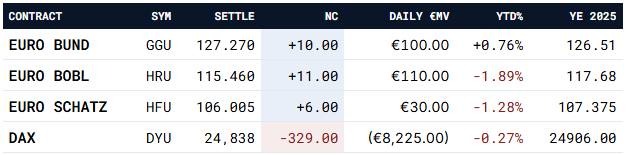
German rates continue tracking the same disinflation bid as US Treasuries, the Bund and Schatz both higher on the day. The DAX is the exception, down 329 points and essentially flat for the year at negative 0.27 percent, the only equity index in this report sitting in the red year to date.
X. Winners & Losers
What You Are Reading
Ranked performance across every market in the daily settle report, three periods, top three names each.
XI. Founders Digital Strategy

***Founding Supporters Maximizes our Push for Decentralization***
What You Are Reading
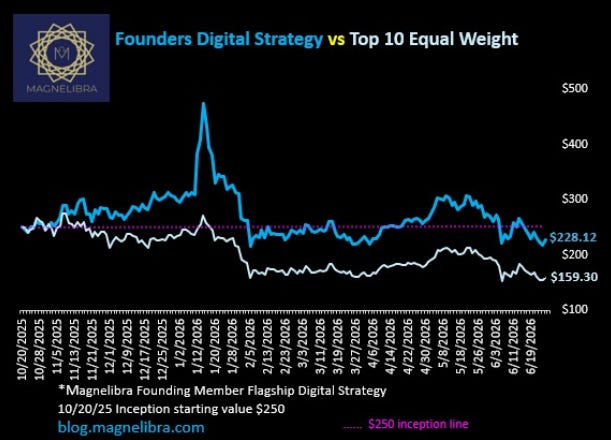
The Founders Digital Strategy is a hypothetical basket model, inception 10/20/2025 at $250. The Equal Weight Basket below tracks the same ten digital assets without the strategy overlay, as a passive benchmark.
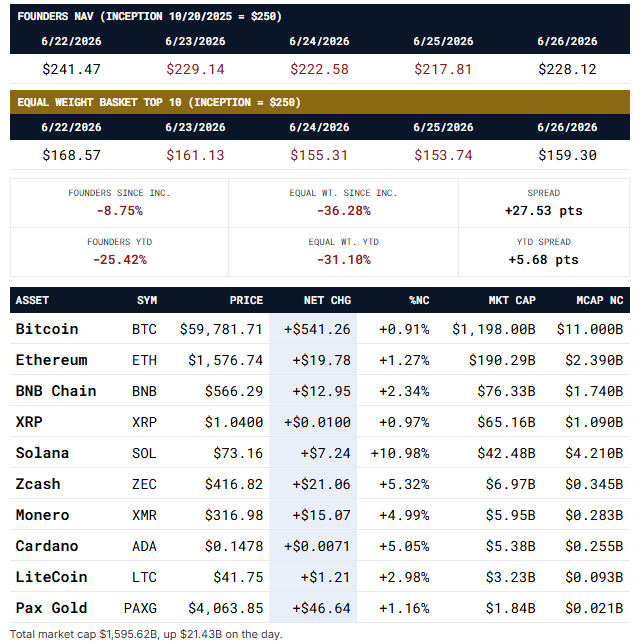
The digital asset basket bounced across the board today, every one of the ten names higher, led by Solana's 10.98 percent jump and Zcash's 5.32 percent gain. The Founders strategy NAV snapped its four day decline, rising from 217.81 to 228.12, a 4.74 percent day, though it remains down 8.75 percent since inception. The strategy continues to meaningfully outperform the passive equal weight basket, down 36.28 percent over the same window, a 27.53 point gap.
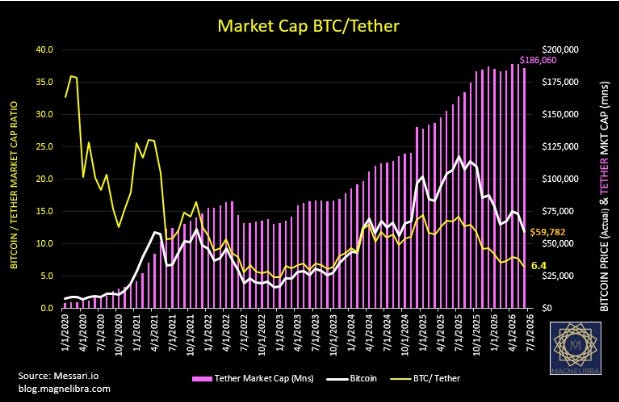
The Bitcoin to Tether market cap ratio held at 6.4, essentially unchanged from last edition, while Tether's own market cap ticked up to 186.06 billion. Bitcoin's 0.91 percent bounce today to 59,781.71 is consistent with the broader risk on day across the digital asset complex, but the ratio itself remains near its multi year low, the same structural point we have made in recent editions: stablecoin issuance keeps growing regardless of which direction bitcoin is moving. We are and remain skeptical of Tether’s integrity.
XII. Strategy Inc (MSTR)
What You Are Reading
Srategy Inc (MSTR) is tracked here as a structural case study, not an endorsement. mNAV is calculated as market capitalization divided by the dollar value of bitcoin held, BTC owned multiplied by spot price. A reading below 1.0x means the stock trades at a discount to the bitcoin backing it, which is the central fact of this section.
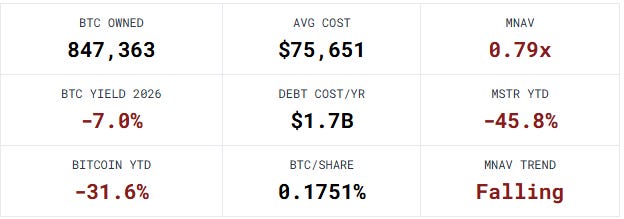
mNAV, the ratio of Strategy’s market value to the dollar value of its own bitcoin holdings, closed the week at 0.79x. Below 1.0x, the entire flywheel that built this trade runs in reverse: every new share sold dilutes existing holders’ bitcoin per share rather than growing it, because the company is raising equity for less than the bitcoin backing it is worth. Independent reporting earlier this month already flagged Strategy trading roughly 17 percent below the minimum price needed to fund further purchases without shrinking bitcoin per share. At 0.79x, that gap has only widened.
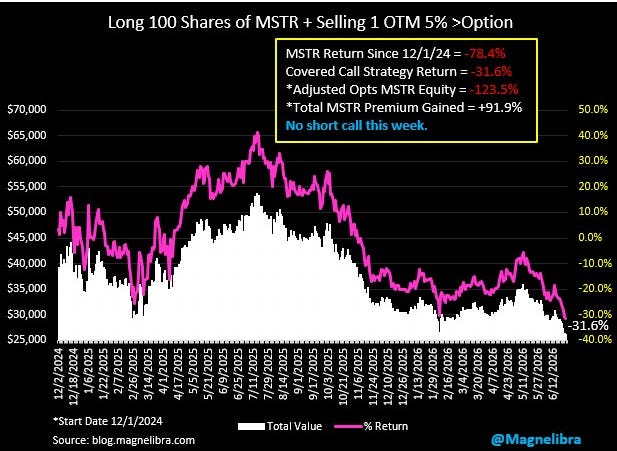
The covered call overlay is now sitting at a negative 31.6 percent return since the December 1, 2024 start date, versus negative 78.4 percent for the unhedged shares, a 91.9 percent total premium collected since inception. No short call is written again this week. This week we will use Tuesday’s opening to sell the 5% otm as a hedge, not Monday.
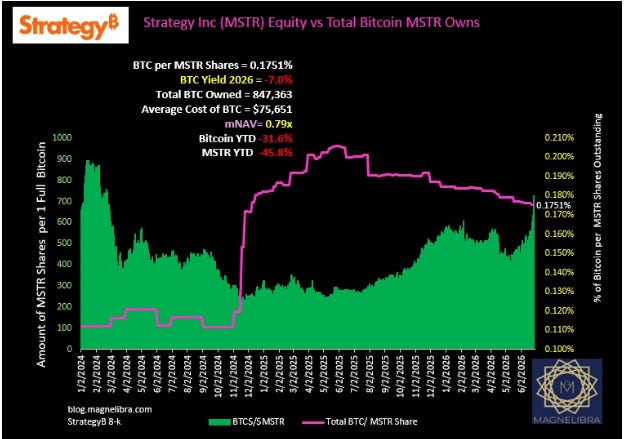
We do not see a clean path out of this for Strategy that does not run through one of three doors: sell more common equity at a discount to NAV, which is dilutive by construction below 1.0x; sell bitcoin outright to fund preferred dividends, which the company already did for the first time in late May; or some combination of both. MSTR is down 45.8 percent year to date against bitcoin's own 31.6 percent decline, leverage working against holders on the way down exactly as it flattered them on the way up. This is the same negative convexity we flagged in STRC months ago, now showing up on the common equity side of the capital structure as well.
The Long View
Markets have spent five years treating every Fed decision as a binary switch between easing and tightening. The interest income channel does not care which switch is flipped. A government this large, financing itself this short, transmits monetary policy through its own balance sheet as much as through bank lending. Watch the mechanism, not the label on the policy.